

A shot in the arm?
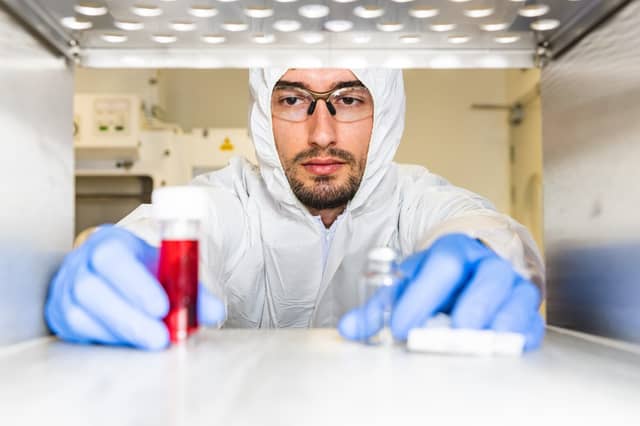

Will Coleraine’s new Centre for Food and Drug Discovery bring the game-changing economic boost that justifies a £22m Growth Deal investment?
THERE are few more worthy activities than finding new treatments for disease.
And Coleraine has scientists who are among the world’s best at doing just that.
With an established reputation in the field of Biomedical Sciences, Pharmacy and Pharmaceutical Sciences, Ulster University’s experts are shaping healthier futures by testing and developing products associated with cancer, diabetes, heart disease, nutrition and vision.
But to produce drugs, you need a commercial sector. It was, after all, AstraZeneca, Pfizer and Moderna who vaccinated the world against Covid.
And while they did so through partnerships with academics, co-operation between the two sectors is, more often than not, conducted on an ad hoc basis.
But there are unrealised opportunities for economic growth for any region that can establish a permanent relationship.
And that’s exactly what Ulster University wants to do for Causeway Coast and Glens with its Centre for Food and Drug Discovery (CFDD).
It’s also why the CFDD is the biggest project to emerge from the borough’s £100m Growth Deal - a funding agreement with specific aims of boosting the local economy and creating jobs.
As the local growth deal partnership enters its final stage of contract negotiations, the Chronicle was invited along to tour the facilities of where the CFDD will be established and meet the man in charge - Professor Victor Gault, Ulster University’s Pro-Vice Chancellor and Executive Dean for the Faculty of Life and Health Sciences.
Professor Gault explained that this centre based on the Coleraine campus will be a unique ‘one-stop-shop’ designed for food innovation and drug discovery.
The facility will give industry partners access to specialist expertise, state-of-the-art facilities and research programmes, supporting the development of new medicines, healthy foods, medical devices and technologies from early-stage discovery and pre-clinical testing through to clinical research and commercialisation.
By working with companies ‘from concept to commercialisation’ the centre aims to support innovation in health by bringing new products to the market much faster and position Northern Ireland as a hub for food innovation and drug discovery.
Professor Gault said: “We are already a trusted partner for businesses in the region but we want to offer a more accessible route, making it easier for them to connect with the university beyond ad hoc interactions.
“We want to reach out to both local companies and multinational companies in the food and drug discovery sector, to ascertain what are the big challenges or problems that they’re facing right now or what they might face in the years to come.”
The ‘one-stop shop’ nature of the CFDD is central to this approach. Rather than companies having to search for different expertise, facilities or specialist equipment, the centre aims to bring these capabilities together under one roof.
It helps that staff in Coleraine are already renowned for research excellence in so many areas – including pharmacy, diabetes, vision science, nutrition, and genomic medicine.
“Organisations may come to us and say they want to test a new product, but they don’t have the specific equipment needed to do that,” Professor Gault said.
“Within the centre, we have that equipment, so we can help them to progress and advise them on the outcomes.”
A demonstration of the resources already available in Coleraine came when the Chronicle was shown a laboratory full of of mass spectrometers - highly sophisticated instruments used to analyse the chemical structure of compounds.
Each piece of equipment performs a slightly different function. And they cost a lot of money. For many companies, particularly smaller businesses, gaining access is a significant challenge.
This gap in in-house research and development facilities is why the centre will investing in even more specialist equipment.
Staff have consulted potential clients, identifying what their needs are and how they can work together to improve competitiveness, increased productivity or create new products.
Professor Gault continued: “Companies can approach the centre with a range of challenges, from understanding how a drug works to determining the best way to deliver it to patients.
“Our pharmaceutical or formulation scientists can test the product and determine what would be the best formulation or effective means of delivery - for example, tablet verses liquid.”
And it’s not only drugs that are the CFDD’s focus. The key role of nutrition in health and well-being, has prompted engagement with food companies.
The research could contribute to the development and testing of new drugs, functional foods and health technologies, with the ultimate aim of improving health and wellbeing and potentially reducing longer-term healthcare burdens.
There’s also the field of medical devices which, it turns out, provide a good real-world example of work staff at CFDD have already carried out.
Neurovalens is a Belfast-based global health tech company that developed a device aimed at addressing the global issue of Insomnia.
Chris Gill, Professor of Digestive Health takes up the story: “The company approached us to design and run robust trials on their insomnia and anxiety devices.
“The project included trial development on data analysis and rigorous submission to regulatory bodies.
The resulting studies provided data that formed part of it’s FDA submission (The USA's Food and Drug Administration) and the company was able to launch the product in the US and is now looking to bring it to the UK market.
Prof Gill explained that as companies like Neurovalens grow they will likely invest in manufacturing, which in turn creates more jobs, from producing and packaging the products to delivering them and providing the regulatory support needed to bring them to market.
In fact there are several ways CFDD activity might generate returns to justify the £22m tax-payer investment.
As Prof Gault explained: “We are already training the talent these companies need by equipping our graduates with skills to support them on their innovation journey. Likewise, as the centre grows we will be able to generate more jobs through Postdoctoral researchers and PhD research opportunities.
But he added: “Our vision is to establish the Causeway Coast and Glens as a leader in the pharmaceutical and food sectors. By supporting innovation in local businesses, we would envisage that they will increase productivity, grow in scale and become more competitive.
“It will create opportunities for companies to spin – in, where they can collaborate on new technologies and innovations in return for an equity stake, or spin-out where new inventions and ideas become commercially viable enterprises.
“Ultimately, by building this regional hub, it makes an attractive proposition for foreign direct investment to locate in the area, benefit from the skills, create more jobs and boost the economy.”