

54% of Borough’s residents ‘unlikely’ to walk just two miles

Survey sheds light on attitudes to active travel
Almost half of Causeway Coast and Glens residents would not be likely to undertake a walk of two miles.
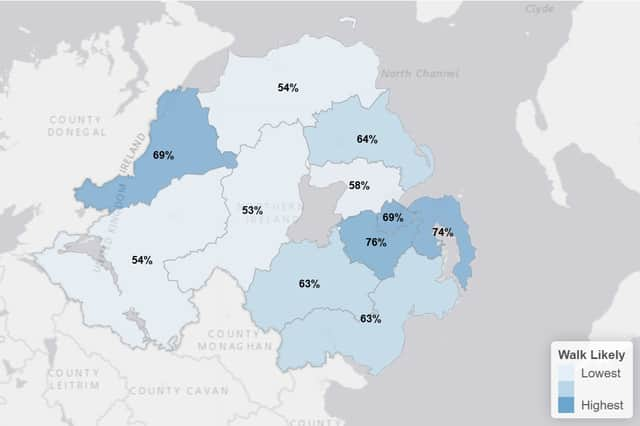
According to a survey on ‘Active Travel’ by Stormont’s Department for Infrastructure, only 54 per cent of people in the borough would be prepared to walk the short journey.
The figure was the second lowest in Northern Ireland.
In contrast 69 per cent of Derry and Belfast citizens were likely to walk 2 miles or more, and three-quarters of those surveyed in Lisburn and Castlereagh would complete the distance on foot.
The good news is, the proportion of people content with current provision for walkers in Causeway Coast and Glens was among the highest in the Province.
Sixty-seven per cent of residents were happy with pedestrian infrastructure compared to only around half the residents of Armagh, Banbridge and Craigavon.
Across Northern Ireland, younger respondents aged 16 to 34 (71%) were more likely to walk short journeys than older respondents aged 65 and over (49%).
Male respondents (68%) said they would be likely to walk short journeys, compared with 60% of female respondents.
Respondents living in urban areas (68%) were more likely to walk short journeys than those in rural areas (57%).
The main reasons respondents said would encourage them to walk (or wheel) more were ‘well maintained pavements’ (41%), ‘safer roads’ (36%) and ‘more safer crossing points’ (25%). Just under a third of respondents (32%) said ‘nothing would encourage me to walk, or wheel, more often.’
Turning to cycling, the survey found that 31 per cent of Causeway Coast and Glens residents had access to a bike - a figure close the Northern Ireland average.
However, only 18 per cent of respondents said the would be likely to undertake a short journey of up to three miles – once again, close to the Northern Ireland of 16 per cent
The borough contained the highest proportion of people who were satisfied with provision of cycling infrastructure (59 per cent).
That figure fell below half in six out of the Province’s 11 local government districts.
Northern Ireland-wide, the survey found that more than two- thirds of respondents held a ‘No way, no how’ attitude to cycling
Seventeen per cent said they were ‘interested, but concerned’ while 11 per cent of respondents were ‘enthused and confident’.
A smaller proportion (3%) described themselves as ‘strong and fearless’ in regard to their attitude towards cycling.
More than three-quarters (79%) of respondents stated ‘no cycle lanes’ as a reason for not being satisfied with current provision for cyclists in their area.
Just over half the respondents (51%) raised concerns over ‘cars driving too fast’ and 44% said there was ‘too much traffic’.
DfI suggests Travel in Northern Ireland is still dominated by private cars
On average around 68% of all journeys are made by car, compared with approximately 24% by walking, 3% by public transport and 1% by cycling, with the remainder by other modes
The department is keen to encourage active travel as a means of reducing emissions and reducing congestion
DfI’s newly published Regional Transport Strategy 2035 states: “For active travel to become the natural choice for shorter everyday journeys, the associated infrastructure needs to be improved, expanded and well maintained. Integrated land use and transport policy will help influence this also.
“The cycling network in particular needs considerable investment for it to become a comprehensive and coherent network that feels safe for everyone to use”.