

What do we know about Causeway Coast and Glen’s migrant numbers?
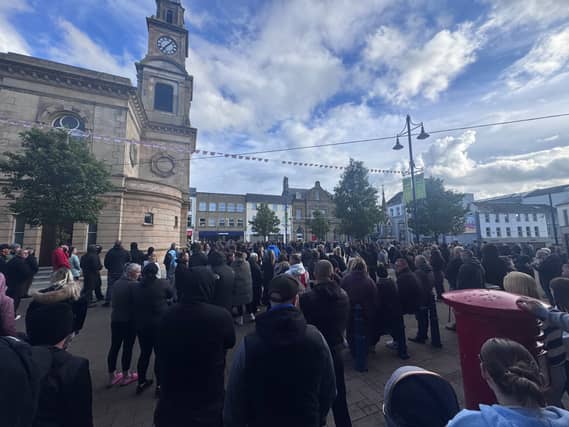

COLERAINE largely escaped the violence seen in Belfast in the wake of last week's horrific stabbing incident.
Nevertheless, dozens of anti-immigration protestors took to the streets over successive nights.
Leading them were representatives from Our Northern Ireland Voice (ONIV) – a group set up earlier this year in protest at what it has described as “illegal and uncontrolled immigration.”
At a town centre rally on Easter Saturday one of the group’s key figures, Dan Grundle warned that Belfast was already unrecognisable and, while the pace of change here was slower, “our wee town” of Coleraine was in danger of being taken by storm.
But what exactly is the current number of asylum seekers living in Causeway Coast and Glens?
Under the Immigration and Asylum Act 1999, the Home Secretary is required to provide accommodation and subsistence support to all destitute asylum seekers whilst their asylum claims are being decided.
A person is destitute if they do not have adequate accommodation or any means of obtaining it, or if they have adequate accommodation or the means of obtaining it but cannot meet their other essential living needs.
Mindful of their impact on communities, the government does its best to disperse these new arrivals across the UK.
Asylum seekers are offered accommodation on a ‘no-choice basis.’ The intention is to distribute supported asylum seekers across the country.
And Northern Ireland is expected to take its fair share.
According to the latest Home Office figures there were 2,379 asylum seekers receiving asylum support in Northern Ireland as of March 2026.
A total of 200 are housed in Causeway Coast and Glens. Of these, 106 are in hotel accommodation.
According to Causeway Coast and Glens Borough Council there is just one hotel operating as “contingency accommodation,” the Magheraboy in Portrush.
The remainder are housed in what the Home Office calls “dispersal accommodation” which is self catered and often in houses of multiple occupancy.
Belfast hosts by far the greatest number of asylum claimants. Most of the 1607 people in the city are in HMOs. That figure equates to about one asylum seeker for every 200 residents.
In Causeway Coast and Glens there are far fewer claimants per head of population, with only one asylum seeker for every 700-or-so residents.
The only other council areas with significant numbers are Antrim and Newtownabbey (212) plus Derry City and Strabane (228).
Though asylum seekers are distributed on the basis of local authorities, council have no funding obligations.
The Home Office secures accommodation via private sector contractors – in Northern Ireland’s case, the Mears Group and support services are entirely funded by central government in Westminster. It is however the council’s role to administer services that help new arrivals integrate.
Last year’s Causeway Coast and Glens Council’s ‘Action Plan’ for delivering these services became the subject of debate.
The plan includes providing access to healthcare and education, English language lessons and information sessions on local customs and civic responsibilities.
The support structures are provided by charities and volunteers and particularly churches which, the officer said, have been “really excellent” in their contribution.
The task of overseeing the work falls to council employees funded by a grant from the Executive Office.
DUP and TUV councillors were among those to raise questions about the extra burden placed on staff.
At the same meeting councillors were told processing times for applications from asylum seekers placed in Causeway Coast and Glens had significantly reduced
As a result Home Office contractors responsible for temporarily housing new arrivals had withdrawn from one of two hotels and are no longer seeking additional properties.
The Magheraboy Hotel in Portrush continues to be used as “family accommodation”, councillors were told.
Borough more ‘white’ than any other district
FOR figures on general migration, its necessary to turn to the 2021 census.
The results broken down into local government districts confirmed that Causeway Coast and Glens is more white, more British and more Protestant than Northern Ireland as a whole.
The borough’s population stood at 141,746 made up of 57,576 households.
Only 10 per cent of Causeway Coast and Glens residents were born outside NI compared to a Province-wide figure of 13 per cent.
And only one percent declared themselves from an ethnic group other than white, compared to three per cent province-wide.