

Ulster-Scots Leid Loanen - the bard who didnae wyte the times, then did!

Naethin bates a haet farl an the company o freens
I’M the soort o boady, who has his bake in a poetry book bravin affen, an ainst in a while I fin a wee verse that dis somethin for me - naw earth movin, but somethin bonnie nevertheless.
This happened a wheen o nichts bak, in a verse o a poem bae Samuel Thomson (1766 – 1816), yin o the first Ulster-Scots poets.
It was a ‘verse epistle’ or letter in verse, tae a Belfast boady, kent only as Mr R, for oddtimes then, just lik noo, folk didnae want their name in print.
The poem is scrieved (written) in what ye ca’l a ‘Standard Habbie’, a common Scots an Ulster-Scots verse form, that aye has six lines, four lang, twa shoort.
On the surface, it’s a freenly affable, encouragin poem, scrieved in the pastoral style.
I wuz readin doon an when I got tae the 10th verse, somethin jumped oot at me.
Here it is, wi an owersetin (translation) fornenst it.
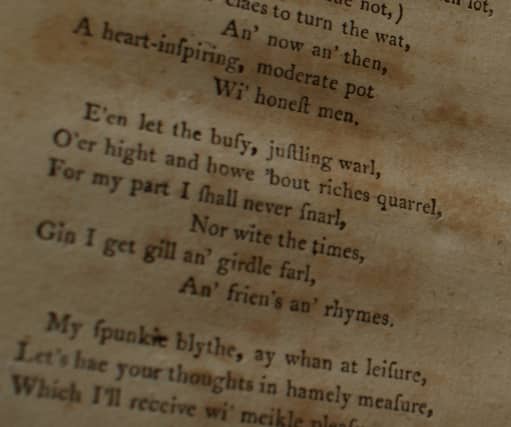
E’en let the busy, justling warl.
O’er hight an howe ‘bout riches quarrel, For my part I shall never snarl, Nor wite the times Gin I get gill an’ girdle farl, An’ frien’s an rhymes.
Owersetin/translation
Even let the busy jostling world, Over hight and hollow about riches quarrel, For my part I shall never snarl, Nor blame the times, If I get a whiskey and griddle farl, And friends and rhymes.
I stapped at: Nor wite the times, for I didnae know what wite meant.
I checked it in baith the Ulster-Scots Academy an Dictionaries of Scottish Language. It’s in baith as blame, mair commonly spelt wyte. Noo the verse wuz getting interestin.
The pictur he paints is gye contented yin.
He is a young man o simple pleasures.Gie him a wee nip o spirits, a hame cooked soda farl, his freens an his poetry an he’s a happy man – yin who didnae wite the times for his problems.
BYORDINAR But this is a byordinar (extraordinary) wee verse in anither wye.
It was scrieved on June 25 1791, when Sam wuz just turned 25, less nor four months afore Wolf Tone came tae Belfast an the United Irishmen wuz formed.
Sam went on tae become a United Irishman, scrieved poetry for their newspaper in Belfast, the Northern Star.
Government repression put folk doon worse an worse, the mair the decade went farrit.
Six year later on May 19, 1797, he scrieved a poem ca’d To The Cuchoo, for the very last Northern Star, ever printed, before the Monaghan Militia, wi the tacit approval of the government, smashed their presses. The second last verse reads.
Sweet bird, sing aloud, Thru’ every green wood, glade and glen, No more tho meet’st a quarrelling crowd, But TRUE UNITED IRISHMEN
It might naw look like much noo, but at the time, the courage tae scrieve this, is byordinar. His life or freedom would hae been at risk comin oot wi such defiance.
This verse is filt wi the emotions o yin who maist certainly wited the times. A verse endorsin a poleetical cause that wited aristocrats, that wited the tyrannical Irish government, that wited the British government, for aal Ireland’s woes.
Looked at lik that, thon wee verse frae June 1791, aiblins (perhaps) is a wee glisk (glimpse) o the unracialized Thomson afore he got poleetical, bravin the storm that ower run thon decade.
Byordinar wee verse. An I reclaimed a wurd o Ulster-Scots leid for mysell, forbye.
Dinnae forget – learn a word, reclaim the leid (language), wi gye an guid dictionaries aye (always) there tae help.
Why not hae a keek (peep) at the http://www.ulsterscotsacademy.com/ or the (Dictionaries of Scots Language) https://dsl.ac.uk/ If ye hear ony rare sounin wurds, or if ye hae a photta wi an Ulster-Scots caption or onything tae add tae wurds or phrases that appear, then contact us on 02827662354, email [email protected]