

Our shared histories explored: Columba and the Canon (part 2)
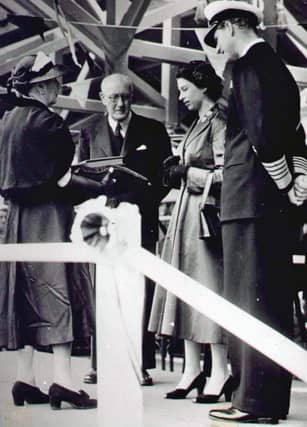

Bert Johnston, local amateur historian, continues his exploration of links between north Antrim and the ancient Kingdom of Dalriada, with a particular focus on the life and legacy of the Rev. Canon John Armstrong, a Rector of St. Patrick’s Parish Church, Ballymoney. His monograph “The History of the descent of Her Majesty from the kings of Dalriada” was presented to Her Majesty Queen Elizabeth II on her visit to Ballymoney on July 3 1953.
A LATE ARRIVAL “‘Sir, sir, sir…!’ a new pupil on the first day of the school year began shouting loudly as he raced down the corridor, ‘Sir, sir… could you direct me to…’
His voice trailed away as he came to a halt in front of me and frantically tried to remember where he was meant to be going and then his face brightened as he seemed to remember. ‘Sir, sir could you direct me to… the Royal Albert Hall?’
I was taken aback by this unexpected request but kept my composure to ask, ‘Do you mean the John Armstrong Hall?’ He immediately agreed that ‘Oh yes sir, that’s the very place!’ I, of course, showed him the way and he ran off as fast as he could go”
(from “A Late Arrival” by Mr. John Stevenson, Vice-Principal of Dalriada School (1974-1998), and Principal of Sullivan Upper, Holywood (1998-2010).
JOHN ARMSTRONG For seven decades, the John Armstrong Hall, with a professionally equipped stage, has been a venue to school and town for assemblies, plays, musicals, concerts, meetings, exams, conferences, shows and fairs.
It was the chief physical education and games centre for pupils before the new, state-of-the art community Sports Complex was opened in 2017.
The Hall is named in honour of the Rev. Canon John Thomas Armstrong, a member of the Board of Dalriada School Governors for 36 years and Chairman from 1947 until his death in 1964.
John Armstrong was born in 1884 in County Down, educated at Portora Royal School and entered Trinity College Dublin on 12th October 1903 aged 19 from where he graduated Bachelor of Arts in 1907, completed the Divinity Testimonium in 1908 and received his Master of Arts degree in 1917.
He became a deacon in 1908 and a priest in 1909.
He was Curate of Ballymore from 1908 to 1911; Derriaghy from 1911 to 1916; Holywood from 1916 to 1920; Diocesan Curate and Inspector of Religious Education in Down and Connor & Dromore from 1920 to 1921. He then became Rector of Ballyphilip and Ardquin (Down) from 1921 to 1935; Ballymoney (Connor) from 1925 to 1959; Rural Dean of Coleraine from 1936 to 1959; Prebendary of Rasharkin from 1945 to 1956; and Chancellor of Connor from 1956 to 1959 in which year he retired. John Armstrong was the son of William Armstrong of Manorhamilton and Fanny (née Brett of Dromore West, County Sligo).
He married Matilda Boyle (daughter of John Sloan Larmor of Fairacre, Derriaghy) on 23rd April 1918 in St. Peter’s Parish Church, Belfast. John and Matilda Armstrong had three children Adrian, Geoffrey and Hope.
ADRIAN AND GEOFFREY Close family friend and parishioner Mr. Ted Gordon (1910-1999) wrote a pageant-play called “Dalriada’ showing the historical importance of the ancient kingdom in British history which was presented at Ballymoney Drama Festival on 11th March, 1938.
It was awarded first place in the class for school plays at the festival and received a very favourable comment from the adjudicator, Miss Helga Burgess.
Dr. Alfred Ross who helped to found Ballymoney Drama Festival and was the Secretary in its early years said, ”
This Play-Pageant was largely founded on a research carried out by the Rector of Ballymoney, Rev. J. T. Armstrong, M.A., and it showed the conquest of Dalriada in Scotland by the Scots (later the Irish) of North Antrim and the foundation of a dynasty there, by Fergus son of Erc, which was later to unite the Picts and Scots under Kenneth MacAlpin from whom the Stuart line claims descent”. John Armstrong’s two sons were players in the “Dalriada” presentation. Adrian was the Prologue and Geoffrey was one of the eleven sons of King Erc. Adrian went on to become the Departmental Manager in the Ulster Weaver Company, Belfast, and was later based in their London Office.
HOPE The sorrows of family life only deepened John Armstrong’s Christian faith. His only daughter, Hope Elizabeth Boyle Armstrong, born on 17th July 1919, died at the young age of 25 on 21st August 1944 in the Rectory, Ballymoney.
She had been suffering from intestinal tuberculosis during her war service in the Censorship Office, Ministry of Information, Belfast.
John Armstrong gave himself to all, and those who knew him were conscious in him of that “unfailing high-hearted happiness which is the fruit of Grace”. Ted Gordon wrote his love poem, “Gold” on 29th May 1938 when he was in Hope’s company, and to which he later added the hand-written dedication, “In memory of H.B.A.”
Evening of mellow Gold, Benignant evening, Waking to woven song The voices of high spring,
Gilding the spire and town And dappled hair of the tree, Touching my spirit with gold, Waking - what voice in me?
Was it a slender flower Haloed in golden mist?
Fay from the nymphs wood With eyes of amethyst?
What was it I saw and heard Before the death of the day?
Amidst the golden trees, a beautiful green bird Ready to fly away?
CANON’S LINK WITH IONA A renewed “patriotism” in North Antrim’s great past and the Scottish Celtic kingdom of Dalriada was engendered by Canon John Armstrong.
During his time as Rector of St. Patrick’s Parish Church, Ballymoney, from 1925 to 1959, he fostered a sense of belonging to the historic Church of Abraham, Moses, Isaiah, St. Patrick and St. Columba.
His passion for local history and especially for the ancient kingdom of Dalriada is evident in the product of his researches in Dublin and Belfast, a monograph called “The History of the descent of Her Majesty from the kings of Dalriada”. This monograph was presented to Her Majesty Queen Elizabeth II on her visit to Ballymoney on 3rd July 1953 during her State Visit to Northern Ireland, accompanied by His Royal Highness The Prince Philip, Duke of Edinburgh, in the month after her Coronation which took place on 2nd June 1953.
Indeed, the spiritual heritage of kingdom and Iona is symbolised by a pink granite stone from Iona Abbey built into a large mural map of the kingdom of Irish and Scottish Dalriada in the King Fergus Wing of Dalriada School.
John Armstrong was the man largely responsible for obtaining this stone in 1955 when he undertook a journey to Iona and it was a result of this journey that the stone was presented by the Right Reverend Sir George Macleod, Bart., M.C., D.D., Moderator of the Church of Scotland and Head of the Iona Community at that time.