

Portrush Heritage Group go back in time to the Bronze Age

Portrush Atlantic Hotel the venue for the group’s Heritage Evening this Wednesday (November 27)
MEMBERS and guests of Portrush Heritage Group will be going back in time this week to the Bronze Age.
The Portrush Atlantic Hotel is the venue for the group’s Heritage Evening this Wednesday, November 27th, commencing at 7:30pm.
Members will be given an update current knowledge of the Bronze Age Village at Corrstown with two presentations by archaeologists Dr Vicky Gin and Dr Kerri Cleary.
Corrstown is a townland located within the outskirts of Portrush adjacent to the Hopefield Road.
Aerial photographs of the area had shown a circular feature in a heavily cultivated field but other than that there was no indication of what lay underneath.
In 2002 an excavation was undertaken in advance of development works into what was initially thought to be a small prehistoric settlement. But as the topsoil was stripped away the extent of the archaeology became clear.
What was uncovered would change our understanding of life in the Bronze Age on the island of Ireland forever.
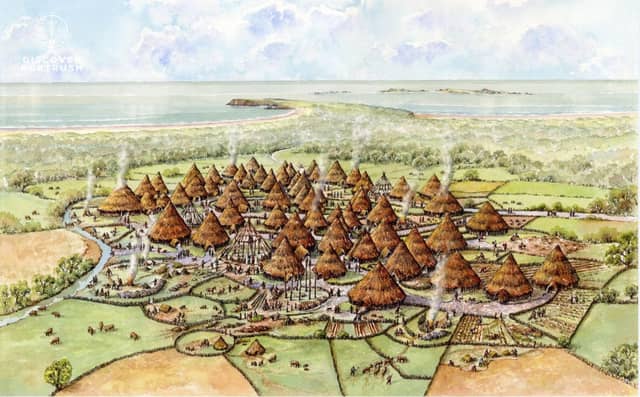
Over 74 houses which ranged from circular to oval in plan were excavated. Subsequent radiocarbon dating placed the settlement in the Middle Bronze Age (c.1700-1200 BC). This provided extensive evidence for a settled and organised Middle Bronze Age village that thrived at Corrstown for over 200 years.
COMPLEX SETTLEMENT The houses were part of a complex and structured settlement with some of the houses linked through sunken cobbled pathways and a cobbled road that ran through the eastern side of the site.
Prominent local historian Mr Hugh McGrattan regards Corrstown as the “jewel in Portrush’s history” and in his book, ‘Portrush The Port on the Promontory’, refers to Corrstown “as a major archaeological discovery which is truly ground-breaking”.
Dr Peter Wilson, Emeritus Reader in Quaternary Environmental Change in the School of geography and Environmental Sciences at Ulster University Coleraine, writing in the Heritage Group Magazine Issue 2 stated: “Even though we know so much about Corrstown, we also know so little.
“While it is wonderful to have all this information available there is something missing from the story – the people of Corrstown. Who were they? Where did they come from? How did they live? How were they governed? Answers to these questions are not easy to give.”
Twenty years after its discovered the November 27th Heritage Evening will examine how new archaeological discoveries and scientific methods are being used to place Corrstown into a greater understanding of life and settlement practices in Bronze Age Ireland and Britain.
ROUNDHOUSES Of the 74 roundhouses discovered at Corrrstown, at least 50 were likely occupied at the same time and these were organised around a large, cobbled road and pathways.
Even now, over 20 years after it was first discovered, this cluster of houses represents an exception for the Bronze Age of Ireland and Britain, and indeed for the prehistoric period as a whole.
Corrstown excavation revealed the largest assemblage of pottery as yet recovered from a Bronze Age settlement site in Ireland, comprising around 9,000 sherds or fragments that represent some 449 vessels directly associated with the roundhouses.
In 2023, through funding acquired from the Royal Irish Academy Archaeology Research Grants, individual sherds from 40 different vessels were subjected to organic residue analysis.
Dr Vicky Ginn’s talk will look at how Corrstown compares to contemporary settlement sites in the ways people were living, and Dr Kerri Cleary will examine what those who lived at Corrstown might have eaten and present results from recent scientific analysis of some of the 449 pots found during the excavations.
All and everyone are welcome, The Heritage Evening is free to members (£15 Annual Subscription) and £5 for visitors. The evening will be available on Zoom to members on request for link to, [email protected]