

'New era for our health service is achievable'
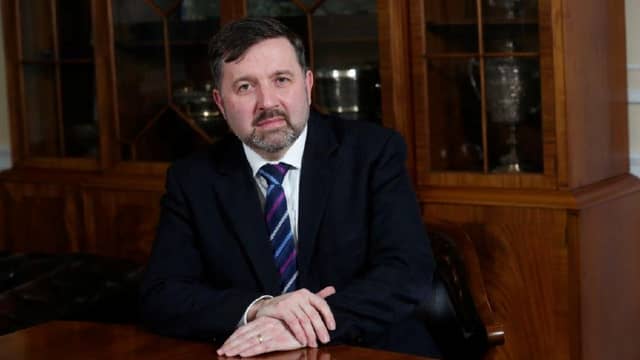

By Robin Swann, Health Minister "I don't know if it's congratulations or commiserations?"
By Robin Swann, Health Minister
"I don't know if it's congratulations or commiserations?"
“Do you know what you’re letting yourself in for?”
“Rather you than me!”
I have had a fair few comments like these, following my appointment as Health Minister in the NI Executive.
I take a somewhat different view, however. I’m incredibly honoured and indeed excited to have taken on this job.
Don’t get me wrong. I’m well aware of the scale of the challenges facing health and social care right across the province. The system is struggling badly, with the strain taking its toll on both patients and staff.
Yet at the same time, the health service is still doing amazing things every single day. We often hear about pressures on services linked to the growing numbers of older people in our community. Yet the very fact so many more people are living longer is a testament to the amazing advances achieved in health care.
It’s well known that I have very personal reasons for being deeply grateful to the health service. My young son Evan spent the first year of his life in Royal Belfast Hospital for Sick Children. My wife Jenny and I saw close up the expertise and commitment of doctors, nurses and their colleagues. We can never thank them enough.
So when the opportunity presented itself to become Health Minister, I simply couldn’t turn it down.
I really believe we have an opportunity to begin a new era for our health service. That will require backing from Ministerial colleagues across the Executive and, most crucially, sustainable financial support. It will also require the public to be willing to accept some change.
Policies across Government impact on the health of individuals and communities. That’s why we will need a joined-up approach across all Departments to make things better.
We’ve made a good start, with the industrial action by three health service trade unions now suspended. I’ve made commitments on pay parity and staffing investment that will be honoured.
Waiting lists and mental health services are my immediate priorities.
However, the pace at which we can tackle the waiting list backlog will depend on the budgets allocated to health over the next few years.
I am heartened at the priority attached to reducing waiting times across all the Executive parties.
As ever with health, it’s not just about money. Alongside investment on reducing the backlog, we have to increase the capacity of our health service to provide more appointments and treatments.
That will involve some changes to the way we currently do things.
Watch out in the months ahead for detailed proposals for elective care centres. These will be standalone centres dedicated to daycase appointments and treatments. Currently, daycase treatments are all too often cancelled as theatres are needed for emergency patients. These new centres will be separate from hospitals with Emergency Departments – which should mean significantly fewer cancellations and increased productivity.
There are also important innovations being rolled out at local health centres, bringing in mental health specialists, physiotherapists and other professionals to work alongside GPs.
As a Minister, I will not shy away from reform if it’s in the best interests of patients. This may well involve some difficult decisions along the way.
Medicine is always changing and, as a result, how we organise services has to adapt as well.
We will need a collective will across the Assembly to make transformation work and to ensure it delivers for the public.
I want to make clear that reform will not be a front for cost cutting. Any changes will be introduced from the ground up, through partnership approaches and public consultation processes, and will be focussed on improving the care we provide.
Mental health and suicide prevention are hugely important issues for our health service. Behind the statistics for lives lost are individual stories of personal and family anguish. We must do better as a society.
I am determined to put concrete actions in place that will make a lasting impact. This will undoubtedly be an Executive priority as suicide is a societal issue which requires the commitment of all parts of Government.
On this and on so many other issues, the people of Northern Ireland are looking to Stormont for collective leadership and policies that make a real difference.
We cannot let them down.