

European Heritage Open Day
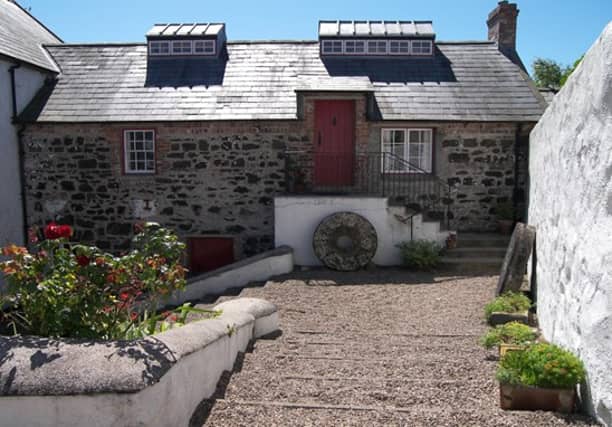

AN open day will take place on Sunday September 11 at Drum Gatelodge, Riverside Road, Ballylough Estate, Bushmills, The Kiln Wing Old Corn Mill, Main St, Bushmills and Magherintemple lodge, 51 Churchfield Road, Ballycastle.
For almost 400 years the water from the Bush River has been used by the world’s oldest licensed distillery for its distinctive whiskey, Old Bushmills.
Until 1949 it also provided the electricity to power the tramway which took generations of tourists along the spectacular Antrim coastline to marvel at the Giant’s Causeway.
But the river has had another important function in the history of the village of Bushmills. It falls some 18 meters in its descent through the village and in the last century provided waterpower for several mills.
Palmer’s Corn Mill looked like a hopeless case when Sam Huey and his American wife, Jan, first saw it in 1986. Gaping holes in the roof, crumbling walls and nesting birds would have deterred most, but Sam Huey had a soft spot for the area – his father was born in the nearby village of Dervock - and he was prepared to rise to the challenge of transforming the mill into a home. He was also prepared to devote the considerable amount of time and money he knew the project would require.
The Kiln Wing is testament to just how successfully a building such as this can be re-used as self-catering accommodation since 2014 and how it is possible to strike a happy balance between conversion and restoration.
The original character of the building has been beautifully preserved with many of the unique elements – including the machine components – have been retained. The cogs and wheels are still at the heart of the building, and glimpses of its former life have been left exposed in nooks and crannies all over the house.
Magherintemple is interesting not only because of its architectural history but also because of its historical importance as the seat of the Casement family. A descendant of the family still lives there to this day.
The lodge was built in the Scottish Baronial style in 1874, possibly by the architect S P Close. At the same time as the lodge was constructed, an extension was added to the main house, also in the same style.
The family believes that the main house was designed by John Lanyon but no definite evidence for the name of the architect survives. The original Georgian House was relatively modest but contained good reeded ornamentation with the Victorian addition containing much fancy pine detailing. It was John Casement, the father of Sir Roger, who built on the Victorian wing, adding a date stone and his initials over the drawing room window.
The Scottish Baronial style he chose was very plain. However, the stepped gables, finials and chimney stacks break up the austerity of the building.
This Victorian addition considerably improved the value of the estate. We know that in 1834, the house was valued at only £11.15.0 and between 1851 and 1879, the house and outbuildings were valued at £25. In 1878 it was shown as “rebuilding”, and in the following year the valuation had shot up to £60.
John Casement inscribed over the front door of his home, “In all thy ways acknowledge Him and He shall direct thy paths” and later in his life decided to take the pledge. Many of the next generation of the Casement family took to seafaring while the fate of another member of the family, Sir Roger Casement, is well known.
The gate lodge provides a fitting entrance to the estate as it echoes the style of the main house. It is of a simple three bay construction with a steeply pitched roof with sawtooth cresting. The walls are constructed of uncoursed squared limestone rising to crowsteps on the main gables which are topped with ball finials and there is the final addition of a date stone over the door. The estate is entered through decorative entrance gates with a circular motif. Concave dwarf walls topped with ornate iron railings with the same circular motif lead up to the gates.
Despite the poor condition of parts of the building, true to Irish Landmark’s philosophy, as little as possible was altered in the course of the conservation project.
The Drum Gatelodge – so named because of its shape - is located just outside the town of Bushmills. It is a very eye-catching dwelling with gothic windows and a distinctive castellated parapet. Over the front door a tiny bull’s eye window lights the landing, to which the stairs wind up from beside the point where the original open fireplace was situated (now replaced by a wood-burning stove). The circular theme is repeated in the piers and iron gates.
History of the Drum
Archdeacon Traill, whose family still own the estate, built the Drum Gatelodge (also known as Ballylough West Lodge) at the end of a long avenue of beech trees at the western entrance to the Ballylough Estate in 1800. The Lodge was tiny, with two rooms linked by a stone staircase. It was a dwelling with no running water, an outside two-holer and you pumped your own water from the well on the opposite side of the avenue.
It was always lived in by estate workers, but there are no records of the occupants prior to 1898 when Lizzie Taggart and her husband came to live there. Both of the Taggarts were employed on the estate, he as a farm labourer, and she as the ‘hen girl’ looking after the geese, ducks and hens.
Mr. Taggart died sometime between 1910–1922 leaving Lizzie with a family of two daughters, named Elizabeth and Martha, and a son called Joseph.
Elizabeth married a Mr. Callaghan and went to live in nearby Castlecatt, where they had a family of four sons and a daughter. Martha moved to Cloughmills and married Mr. White, a farmer. Robbie (Robert), one of her children, was sent back to be reared by his grandmother at the lodge. He was sent to the local school at Ballylough, became a bus driver, and lived at the lodge with his grandmother until her death in 1962. Robbie then came to live in Bushmills, where he set up a small business in the Main Street and died in his 70s.
For more info, go along to the open days on Sunday September 11.