

Court of Appeal rejects doctored quarry map claims

Judges rule in favour of council over refusal to take enforcement action
THE Court of Appeal has rejected allegations that a quarry operator’s planning permission is based on a fraudulently altered site map.
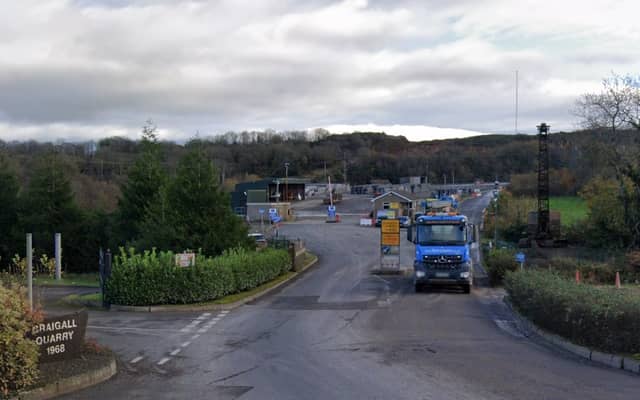
The claim was made by an environmentalist who challenged Causeway Coast and Glens Council’s refusal to take enforcement action against the owners of Craigall Quarry near Kilrea.
Gordon Duff describes himself as being “passionate about the countryside” and is part of “a large environmental activist network.”
His case ended up in the Court of Appeal when he was refused leave to seek a judicial review of the council’s decision.
His allegation that a 50-year-old site map was doctored to enlarge the area where quarrying operations are permitted is outlined in the Court’s judgement delivered on September 20.
By way of background, the judges explained how a local couple made a complaint to the DoE (Department of Environment) in 2012 alleging that the development rights in respect of quarrying had expired.
The department conducted an investigation in 2014 but concluded no breach had occurred based on a 1964 map obtained from the quarry’s original owner, delineating the extent of the quarrying operation with a ‘red’ line.
The case was taken up by Mr Duff in 2021.
He obtained a copy of the site map endorsed with a ‘pink’ line delineating the boundary of the quarry but otherwise baring the same date stamp and other annotations as appeared on the original source site map.
And in his appeal over the Judicial review ruling, he submitted that the council had wrongly accepted a fraudulent site map as authentic.
“The central plank of the appellant’s case is that the site map attached to the original permission granted in 1964 has subsequently been fraudulently altered by the addition of red/pink lines which effectively extend the boundary of the quarry covered by the 1964 permission,” wrote the judges.”
They added: “As a result, he submits all quarrying outside this original area is unlawful and the respondent ought now to issue enforcement proceedings due to the destruction of priority habitat.”
The Appeal Court heard submissions from the council and the quarry owners that Mr Duff did not have sufficient interest or ‘standing’ in the matter to mount a judicial review.
The judges accepted that the appellant has “a genuine concern for the environment” and was “well meaning and enthusiastic, but lacked specialist knowledge of the environmental matters in play and had few resources available to him to source environmental and legal expertise.”
It was also worthy of note, they said, that no responsible environmental group has sought to bring a challenge in this case.
And in answer to Mr Duff’s submission that ‘standing’ could be based on the need to ensure against fraudulent conduct or breaches in the rule of law, the judges suggested ‘suspicions’ over the map were no substitute for credible evidence.
The judgement states: “In his various affidavits and submissions the appellant set out the reasons why he considered the site map has been fraudulently altered and is not a true copy of the original site map.
“When pressed by the court, however, he accepted that he had only a ‘suspicion’ about the veracity of the site map.”
The judgement continued: “The appellant has to persuade the court that he enjoys an arguable case with realistic prospects of success in order to secure a grant of leave.
“When alleging fraudulent behaviour the burden of proof is upon him to produce evidence in support.
“Mere suspicion of some fraudulent modification of documentation does not meet the well-established principle that fraud must be pleaded with full particulars and based on credible evidence.”