

Causeway Hospital: in the eye of a political storm
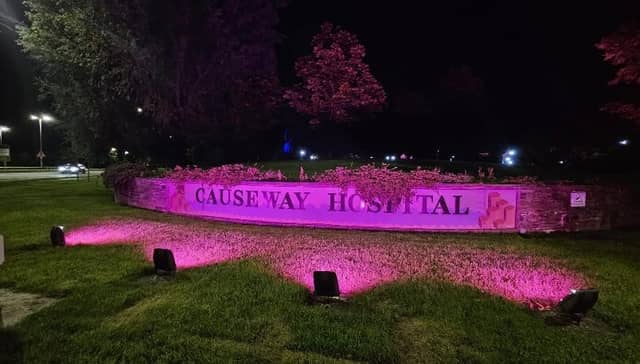

The Chronicle looks at the origins and fallout from plans to transfer emergency general surgery that prompted the Health Minister's resignation
TO some, Mike Nesbitt was a distant bean-counter preparing to deprive Coleraine of an essential service.
To others, he was Stormont's only courageous minster ready to take the tough decisions needed to save Northern Ireland's crumbling health service.
Although you have to travel beyond the Causeway Coast and and Glens are to hear the second view, there are some significant voices in his defence.
Dr Alan Stout, for example, chair of the BMA’s Northern Ireland council, described plans to centralise emergency general surgery at Causeway Hospital as ‘a relatively small change.’
And, he said, it was worrying that it had created a crisis large enough to prompt Nesbitt's resignation.
“It's always far too easy to play the populism card, to promise what is undeliverable,” he said.
“What we actually need at the moment are politicians who are prepared to stand up and make the difficult decisions.”
Those that disagree would doubtless reject any notion that Nesbitt was a victim of 'parish-pump politics' – when elected representatives throw weight behind a local campaign because they are more worried about losing votes than the wider population's interests.
North Antrim MP Jim Allister, for example, insisted lives were at stake.
“With the removal of such a vital service from this part of Northern Ireland, the implications are unconscionable,” he argued.
“The extra time required to transport critically ill patients needing immediate surgery to Antrim instead of Causeway could mean the difference between life and death. Further, how will the already stretched Antrim Hospital be able to adequately manage the additional workload?”
With such disparate interpretations, it’s worth looking back at how we arrived at the crisis and ask whether the Trust's centralisation plans are indeed 'a relatively small change' or a matter of life and death?
So, what exactly is emergency general surgery? According to Ulster University's Professor of Social Policy, Dierdre Heenan, over the past few days, even media outlets have seemed confused, using the terms ‘emergency general surgery,’ ‘emergency units,’ ‘emergency surgery’ or ‘emergency services’ interchangeably.
In fact, EGS usually refers to the evaluation, diagnosis and treatment of sudden acute abdominal conditions such as bowel blockages, hernias, perforated bowels or severe infections.
“Currently throughout Northern Ireland it is not unusual for surgery to be performed hours after diagnosis without any adverse effects. Patients are routinely transferred to another hospital for treatment after diagnosis,” said Prof Heenan
“A number of expert reviews have stated that it is neither appropriate nor feasible to have emergency general surgery in every hospital in the north.”
The road to the current crisis began in 2022 when the Department of Health conducted a review led by respected surgeon Prof Mark Taylor.
He concluded that creation of ‘high volume centres of excellence’ led to much better outcomes for patients and a fertile environment for training development of skills, and modernisation of practice.
His review identified one of the underlying causes as ‘the co-existence of elective and emergency/unscheduled care.’
Prof Taylor's conclusions prompted the Northern Trust to launch a public consultation on plans to transfer all emergency general surgery to Antrim and develop a unit dedicated to planned procedures at Coleraine.
Amid increasing recruitment difficulties, Trust officials said it was no longer able to sustain both disciplines across two hospital sites and creation of an ‘elective and diagnostic hub’ at Causeway Hospital would help reduce Northern Ireland's lengthy waiting lists.
But the Trust also made efforts to reassure the public that Causeway's 24/7 Emergency Department was not threatened by the proposals.
Emergency cases would still be assessed in Coleraine by surgical consultants and transferred only if a lifesaving operation was needed.
The plans were duly adopted by the Trust's board in May 2025. It only remained for the Health Minister to sign off, but officials were in no doubt a PR battle was far from finished.
The same day the board adopted the proposals, the Trust's Director of Operations told The Chronicle she accepted reforms would not be welcomed by some in our local community who had raised ‘very genuine concerns.’
“Should service change go ahead, we will do all we can to build public trust and confidence by ensuring that the transition to a new model will be as smooth as possible, for both our patients and staff,” she said.
But that public trust did not materialise.
And it wasn't only vote-hungry local politicians fuelling opposition.
The Chronicle spoke to four retired Causeway Hospital doctors who suggested the Trust failed to provide evidence that centralising acute surgery would be safer.
They insisted increased admissions in Antrim would result in overcrowding and adverse effects on other departments. Meanwhile, the removal of general surgery places Causeway's ICU and the A&E departments in doubt over the next 5-10 years, they said.
The Trust, the doctors concluded, was ‘sacrificing’ Coleraine's surgical team to address staffing difficulties in Antrim.
In response the Trust said the safety of patients and the wider community ‘remained an utmost priority,’ which is why it was proactively planning to avoid an inevitable service collapse and the associated risks that would create.
One of those doctors was on stage last Thursday night at the town hall rally that prompted the latest chapter in the saga.
But it wasn't repeats of the claims that precipitated Mike Nesbitt's resignation. It was the fact that they were backed by his party leader Jon Burrows.
He said he did not agree with the Trust's plan and would ‘never agree with it.’
“Emergency surgery must remain at the Causeway Hospital and it should be built up, not run down and that is my position and it's not for negotiation.”
Nesbitt resigned less than a week later.
In his resignation letter, he said that when Burrows became party leader, he told him his ‘one 'red line'’ was puberty blockers and his ‘opposition to Northern Ireland participating in the Pathways trial.’
In a copy of the letter he sent to Burrows, posted on social media, Nesbitt said the party leader had now ‘introduced a second red line’ regarding the EGS at Causeway Hospital.
Nesbitt said he had discovered Burrows' view of ‘issues under [his] purview’ by "monitoring the media.
“Yesterday, I offered you a way to manage this situation. As I have not received a timely response and given the shock waves you have created in the HSC system, this matter needs resolved,” he said.
Whether the former minister was minded to approve the Trust's plans is not clear.
But, earlier in the year, he'd assured Stormont's Health Committee that any decision he took would be based on ‘patients outcomes’ rather than party political considerations or parish pump politics
“I am unencumbered by the search for votes because I will not be standing on May 6, 2027 and I give you an assurance that if I feel the party is trying to influence how I do my role I would rather walk, resign, step away than become some sort of lap dog or functionary for a political party,” he said.
Nor do we yet know how the new minister will give the Trust the green light.
One thing for sure is that campaigners for Causeway Hospital will not relent.
On Thursday the Chair of Causeway Hospital SOS, Gemma Brolly, said that the new Health Minister must prioritise and defend services at Causeway Hospital, after the resignation of Mike Nesbitt.
“My priority and that of my colleagues is to halt the pattern of stripping essential services from Causeway Hospital in an effort to prop up Antrim Area Hospital, beginning by ensuring emergency general surgery is maintained at Causeway Hospital - that is something that is only emboldened by this political bombshell.
“I am now calling on the Ulster Unionists to ensure that their new Minister, in line with their Leader, commit to meeting the aims of our community at Causeway, which we will not yield.”
It is an entrenched position that has frustrated many of those who admired Mike Nesbitt’s principled stance but lament his departure, given the decision he looks likely to have made
They are mostly, of course, not from Coleraine .
And one is the BMA's Dr Alan Stout who said perhaps the most important lesson was around communication.
“I do have a degree of sympathy with the campaign groups and local politicians, I think to break the cycle we need a much better articulation of the plans.
“It’s not about losing things and services, what we need is for the transformation of health services to be multi-factorial.
“That means you bolster a lot of services whilst potentially taking parts away to make them better.
“That’s what people don’t see, they only see things being taken away in a crisis environment.
“I think in fairness to a lot of people who campaign against it, the problem is that it hasn’t been explained well enough.”