

Ulster-Scots ‘Leiders Gaitherin’ at Ross Park
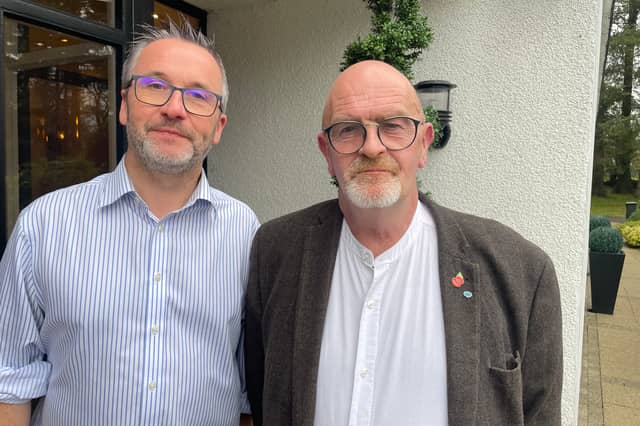

Ulster-Scots Leid Loanen: activists workshop at Ross Park Hotel
THE recent gathering of Ulster-Scots activists in the Ross Park Hotel, near Ballymena, was well attended by folk from the Coleraine, Ballymoney, Dervock and Garvagh areas.
The event, organised by the Ulster Scots Agency, included a diversity of people from across the sector, with the aim being to create a sense of purpose and unity.
The title of the event ‘Leiders Gaitherin’ is a wordplay on the Ulster-Scots word for language ‘leid’ with many present being leaders in their own areas.
Some attendees of the ‘Dinnae Houl Ye Wheesht’ leid classes, organised by the Ulster-Scots Agency Language Development officer, William Olphert were also present.
William said: “I was delighted to see a room packed at the Ross Park for our inaugural LEIDers gaitherin.
“We wanted to see every aspect of the Ulster-Scots language world represented and we had that. Oul hauns and green galoots.
“There was diversity of thought but a great sense of togetherness. Let’s hope with regular gaitherins like this and other new shoots sprouting from today, we can see an active, wide reaching, influential, stronger, more united speech community that leads other folks into our language.”
The workshop format was interspersed with readings of work by a number of the participants, including Dervock’s Charlie Gillen, who read a poem appropriate to this period of remembrance.
Ulster-Scots and Ulster British Commissioner, Lee Reynolds read from his father Charlie’s poem ‘A Heirskip Loast.’
Commenting on proceedings, the Ballysally man said:“A richt an blythe day gaitherin fowk frae aa airts an pairts; new an aul tae tha revival forbye.
“ Aa brocht thegither tae graith tha Ulstèr-Scotch leid in tha yeirs aheid.”
Many issues were discussed, central among them education and how best to take the leid forward into the future, with many ideas generated on how best to do this.
Perhaps the matter that arose the most passionate feelings was the issue of conservation versus reclamation.
Some see the reclaiming of words that have fallen out of use, that are found now only in books, as an essential part of building and strengthening the language going forward.
Others feel that only words that still survive in the community should be used, seeing reclamation as a departure from authenticity.
Though strong feelings were felt on either side, the discussion remained polite and constructive.
People were agreed that the variety of language that exists in different areas, should be nurtured.
It was clear that not a few Ulster-Scots creatives had taken part in positive collaborations with those from the Irish language sector, running counter to some preconceptions that the two languages are somehow at loggerheads.
The natural, organic and unforced nature of these activities, was noted.
Frankie Cunningham, from Dervock, said: “I thought it was worthwhile, necessary in fact...reconnect the next generation with their Ulster Scots language and heritage, encouraging them to use it in both its written and spoken forms. Keeping it alive means passing it on, giving young people the confidence to make it part of their everyday lives.”